
ISSI Seminar Highlights Legal and Strategic Risks of Undermining the Indus Waters Treaty
 thefridaynews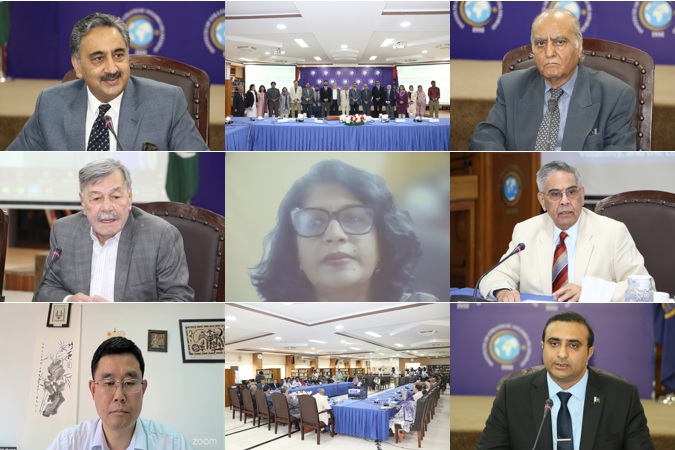
India Study Centre at the Institute of Strategic Studies, Islamabad organised an international seminar titled “Weaponisation of Water: Legal and Strategic Implications of Undermining the Indus Waters Treaty” on June 10, 2026. Mr. Ahmer Bilal Soofi, former Minister of Law, Justice, Parliamentary Affairs and Human Rights graced the occasion as Guest of Honour. Other speakers included Dr. Sofia Khanom, Research Director, Bangladesh institute of International and Strategic Studies, Dhaka, Ambassador Shafqat Kakakhel, Chairperson, Sustainable Policy development Institute (SDPI), Dr. Zhang Jiadong, Director, Center for South Asian Studies and Dean, Institute of Strategic Studies and International Security, Fudan university, Shanghai, China, and Mr. Ali Tauqeer Shaikh, Senior Consultant, Asian Development Bank.
Addressing the gathering, Mr. Soofi said that Article 12(4) of the Indus Waters Treaty (IWT) clearly states that the treaty can only be modified if both parties agree to do so and that it cannot be abrogated or legally suspended unilaterally. Indian Prime Minister Narendra Modi had declared his intentions about the fate of IWT as soon as he assumed power in New Delhi in 2014. This intent was mainly driven by the internal politics of India and the promises made by Indian Prime Minister Modi during his election campaign. He said that post-Pahalgam incident, there was no investigation and took a hasty decision of holding the treaty in ‘abeyance’ giving an impression as if India had been waiting for this opportunity. Mr. Soofi highlighted the fact that many countries in South Asia like Bangladesh are lower riparian countries and India’s tinkering with IWT poses a direct threat to such countries. Besides the water, the region is also facing the threat of ‘Akhand Bharat’ ideology where India desires to re-unite the region as one entity.
In his welcome remarks, Ambassador Khalid Mahmood, Chairman, Board of Governors, ISSI, said that South Asia is one of the most water stressed region in the world. Instead of cooperation, India chose to politicise this very important issue. Water should have been a bridge of cooperation but it has become a dangerous threat to peace and security. Ambassador Mahmood stressed that the IWT is not a political concession to be suspended at will. It is an international treaty, binding in law, and it contains no provision for unilateral abrogation or suspension. Any attempt to alter, suspend, or undermine it unilaterally has no legal standing. Pakistan’s position is principled and consistent. Pakistan remains firmly committed to the IWT and to the peaceful, lawful, and institutional resolution of all outstanding disputes. Pakistan expects India to immediately rescind its unilateral and unlawful stance and restore the full implementation of the treaty in letter and spirit. At the same time, Pakistan will continue to protect its legitimate rights and entitlements under international law and under the treaty itself.
Earlier, in his introductory remarks, Dr. Khurram Abbas, Director India Study Centre, said that Before April 2025, the Indus Waters Treaty used to be described as one of the most successful and durable water-sharing agreements in modern history. However, the developments of the past year have brought the future of the Treaty into question. India’s decision to place the Treaty “in abeyance” have generated serious concerns regarding regional stability, international law, and the future of transboundary water governance in South Asia. He apprised the audience regarding various Indian projects that are at various stages of completion and highlighted that fact that India has invested more than 41 thousand crore Indian Rupees in various hydropower projects post holding IWT in abeyance and fast-tracked various controversial projects.
Dr. Sofia Khanom, said that contrary to general perception, Bangladesh is a water stressed country. It is only during the Monsoon season that there is water everywhere but for rest of the year, Bangladesh experiences shortage of water. Additionally, there are effects of climate change as well. There are fears that almost 20 percent of Bangladesh will be submerged by 2050. Roughly, 40-60 percent of the population of Bangladesh lacks access to safe water. 73 percent of people living along the coastal areas are forced to drink saline water. Heavy reliance on groundwater irrigation is resulting in depletion to alarming levels. She said that conflicts over water are increasing day by day across the world and it will be more intense in coming years. There is an emphasis on institution-based solutions through water diplomacy to facilitate negotiations. However, emerging powers in Global south are reluctant to allow external actors for water diplomacy.
Ambassador Shfqat Kakakhel, said that IWT is a remarkable treaty that was signed after negotiations for 9 years. Signing of IWT set an example across the world and following it, some 145 transboundary agreements were signed across the world. Article 9 of the treaty shows a clear path for settlement of disputes and differences. India has taken number of steps that goes against Pakistan’s water rights. Hence, protection of IWT is not only in Pakistan’s interest but also in the interest of all lower riparian countries of South Asia and the world at large.
Dr. Zhang Jiadong, explained the historical context of IWT and explained that following partition, India unilaterally cut off eastern river supply creating a crisis situation in Pakistan. From 1954 – 60, World Bank negotiated a settlement between two countries and finally, IWT was signed in 1960 with multi layered conflict resolution mechanism. It survived wars and was regarded as ‘model of water cooperation between hostile states.’ In 2025, IWT was systematically eroded by unilateral declaration by India of holding the treaty in abeyance. Dr. Zhang stressed that protecting the legitimate rights and institutional resilience of downstream vulnerable parties is a shared international responsibility.
Mr. Ali Tauqeer Shaikh, highlighted that instead of a negotiator, engineers have been fighting the case for Pakistan under IWT. He also highlighted that Pakistan ignored the early signs of Indian intentions regarding IWT. Indian decision to hold IWT in abeyance did not come in the aftermath of Pahalgam incident. Instead, after attack on Pathankot and Uri, the meetings under IWT were cancelled by India. He said that Pakistan can have all information from satellites and therefore, it should not depend on India for information.
The deliberations were followed by a question-and-answer session. The event was attended by members of the diplomatic corps, academia, policy makers, intellectuals and students