

 thefridaynews
(Report by Hassan Raza)
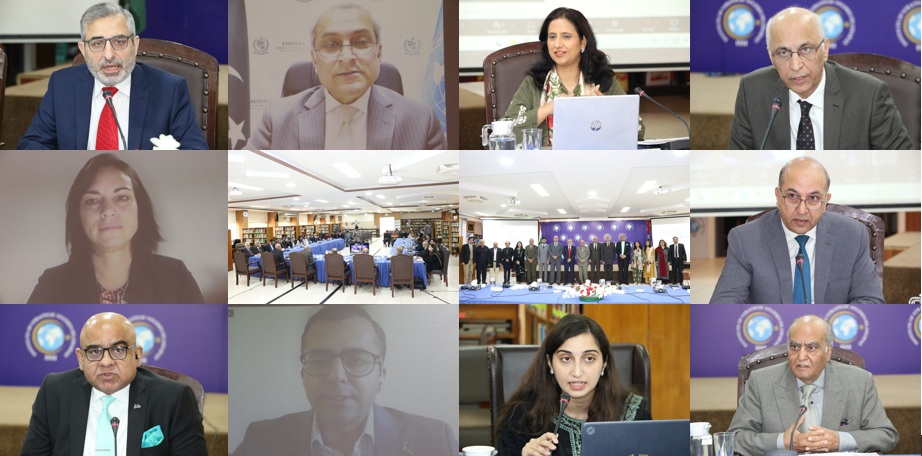
“An unregulated competition in Lethal Autonomous Weapons Systems (LAWS) would be costly and destabilizing, particularly in a region like South Asia where the warning times are short, and crises move fast.” This was stated by Ambassador Tahir Hussain Andrabi in his video message to the participants of the seminar titled “Lethal Autonomous Weapons: From International Deliberation to a Legal Response,” hosted by the Institute of Strategic Studies in collaboration with Sustainable Pace and Development Organization (SPADO).
The event was attended by strategic experts, academicians, and diplomats. Ambassador Tahir Hussain Andrabi stated that Pakistan has been actively engaged on LAWS since 2013, when few countries were paying attention to the issue, calling for regulation and governance of weapons that transfer decisions on the use of force from humans to machines. He underscored that besides humanitarian risks, Pakistan has also been highlighting the security dimension of LAWS and their implications for regional and global security and stability.
Speaking on the “Global Movement against LAWS,” Mr. Raza Shah Khan, Executive Director, SPADO, highlighted that LAWS use artificial intelligence to identify, select, and engage human targets without human intervention, raising serious concerns regarding their ability to distinguish between civilian and military targets. He also discussed the role of the Campaign to Stop Killer Robots in advocating the peaceful use of technology and a ban on LAWS. Ms. Nicole Van Rooijen, Executive Director, Campaign to Stop Killer Robots, traced international deliberations on LAWS, which raised fundamental ethical questions about delegating life-and-death decisions to machines. She commended Pakistan’s longstanding leadership and its instrumental role in advancing efforts towards a much-needed sixth protocol to the CCW on autonomous weapon systems to ensure compliance with international law and the protection of civilians during armed conflict.Dr. Adil Sultan, Dean, Faculty of Aerospace and Strategic Studies, Air University, Islamabad, highlighted the growing role of AI, cyber, and quantum technologies in future warfare, emphasizing the risks of entanglement between conventional and nuclear operations. He underscored the limitations of traditional arms control frameworks, the absence of a comprehensive international instrument governing emerging military technologies, and the gap between technological advancements and arms control negotiations. He further stressed the need for adaptive verification mechanisms to address emerging challenges.Dr. Rizwana Abbasi, Professor, National University of Modern Languages (NUML), highlighted the distinction between military AI and LAWS, emphasizing the degree and scope of autonomy in weapon systems. While acknowledging their operational advantages in terms of speed, coordination, and efficiency, she underscored their implications for strategic stability, including accidental escalation, miscalculations, and shrinking decision-making time, leaving limited room for diplomacy.
Ambassador Moin ul Haque, Director General, ISSI, highlighted that advance in military technology have historically outpaced international regulatory efforts, with autonomous weapon systems exposing similar limitations in existing arms control frameworks. He stated that while autonomous functions are not new to military systems, the growing possibility of machines independently making lethal decisions has serious humanitarian, legal, ethical, and security concerns, particularly regarding civilian protection and accountability.In his introductory remarks, Mr. Malik Qasim Mustafa, Director, ACDC-ISSI, highlighted how the growing weaponization of AI is transforming warfare and generating complex security challenges. In the South Asian context, he noted India’s accelerated development of autonomous weapon systems following the May 2025 conflict as part of its preparations for non-contact warfare, further adding to regional security concerns.
In his concluding remarks, Ambassador Khalid Mahmood, Chairman BoG, ISSI stressed the need for a legally sound and practically effective international response to LAWS. He emphasized that progress depends on states’ willingness to translate shared concerns into meaningful international commitments. He concluded that while technological advancement cannot be prevented, technological progress and human responsibility must go hand in hand.